CubeNet M3: A cute, little, big leap.

목차
Abstract Following the structural optimizations of CubeNet M2, CubeNet M3 confronts the fundamental mathematical limits of combinatorial optimization. While M2 refined the neural backbone, it inevitably hit a wall where the greedy solve rate collapsed to 0% at exactly Level 6. M3 reveals that this plateau was not a hardware or capacity issue, but a flaw in the data itself; Poisoned Labels. By abandoning supervised scramble targets and adopting the Pure DAVI (Deep Approximate Value Iteration) philosophy inspired by DeepCubeA, M3 shifts the paradigm to autonomously discovering the true shortest path.
Introduction
CubeNet M2 proved that a ResNet backbone and a well-engineered Replay Buffer could maximize training throughput. However as the scramble depth increased, the greedy search success rate plummeted to 0.2 at Level 15.
To overcome this massive plateau, we deployed nearly every weapon in the modern deep learning arsenal. We scaled up to a massive ResNet backbone, introduced Dual Head architectures, utilized high-dimensional Embeddings with a 4096-dim Expansion Bridge, and even implemented complex RL algorithms like Rainbow DQN alongside various heuristics. But everything failed.
The root cause was not the architecture, but the dataset. In a Rubik's Cube with a branching factor of 12, roughly 73% of 6-move random scrambles can actually be solved in 4 or 5 moves. By teaching the model that a 4-move state was a 6-move state like it's Supervised Learning, we were feeding it poisoned data. The approach only worked at the level 1 to 5. Forced to memorize a distorted topology, the search algorithm was blinded. To shatter this plateau, we overhauled the entire paradigm of how the model perceives the world.
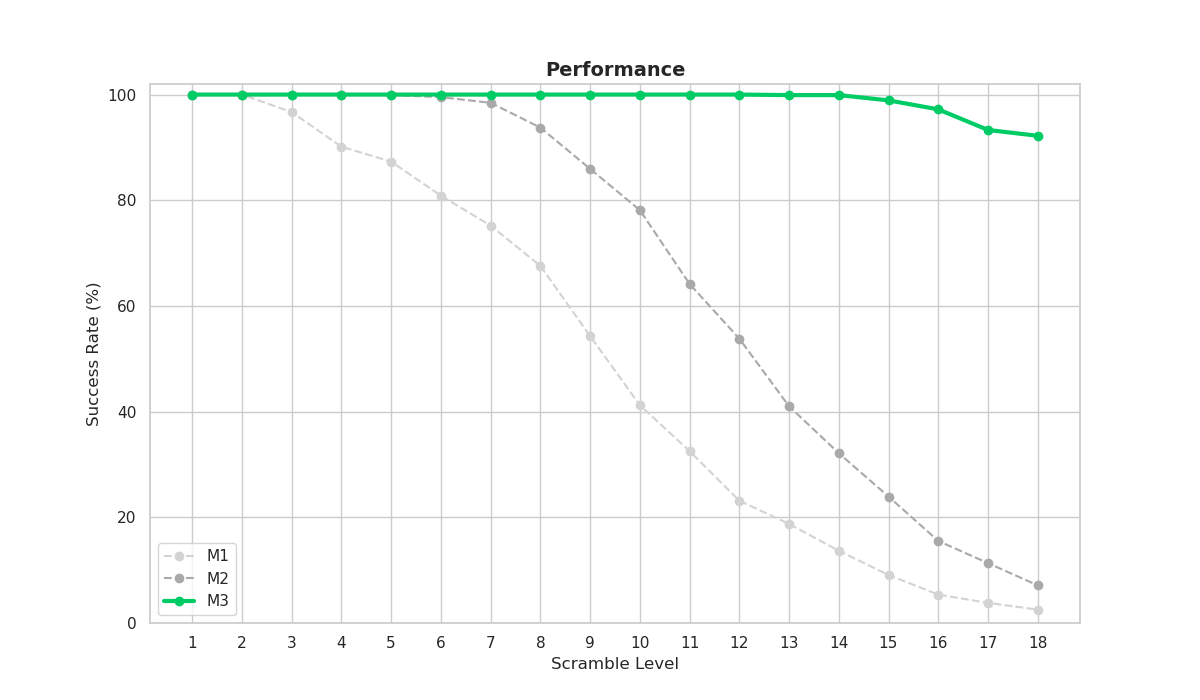
Architecture & Optimization
Algorithm
M3 discards scramble count labels entirely. Instead, the model bootstraps its own intelligence using the Bellman Equation.
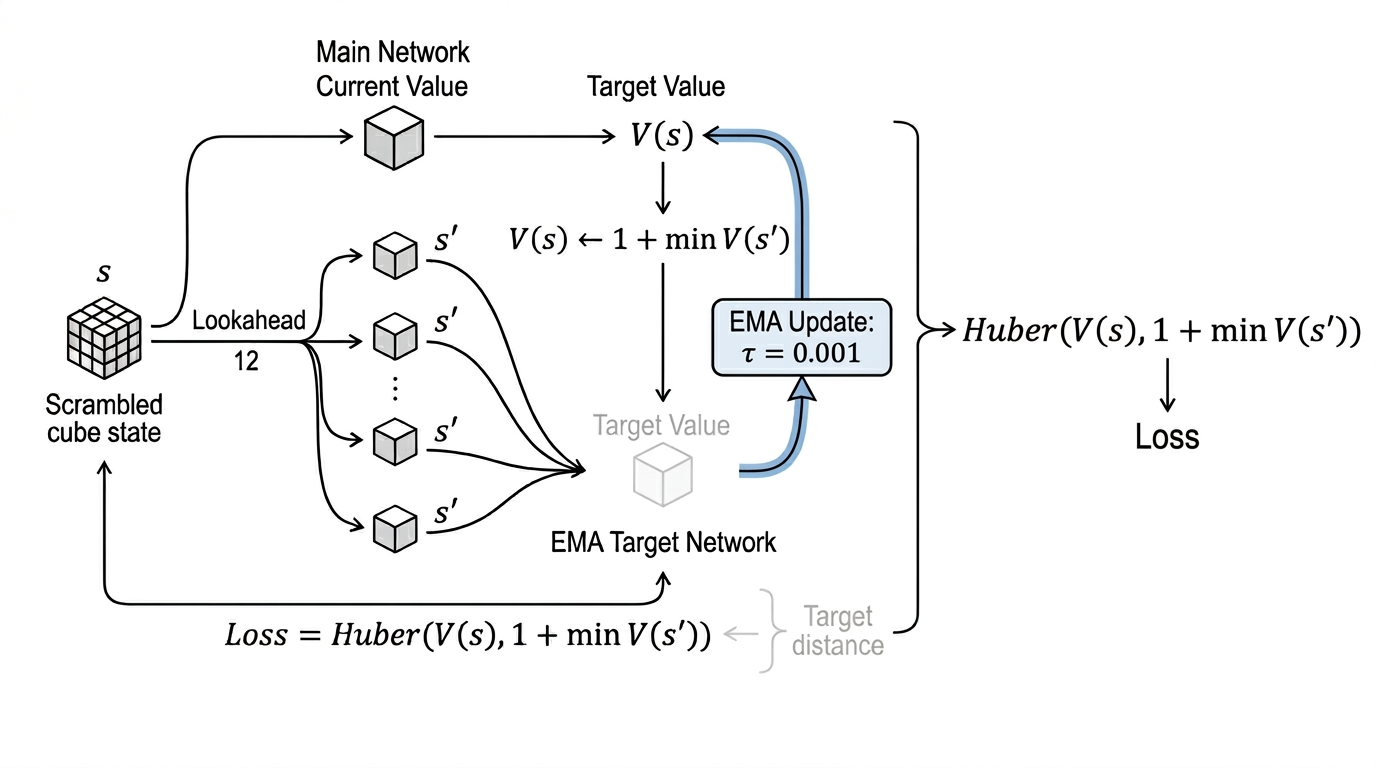
DAVI(Deep Approximate Value Iteration): The model looks one step ahead into all 12 possible child states, evaluates them using a Target Network, and learns its true distance by picking the best next step + 1.
EMA Target Network: To solve the Value Propagation Delay caused by a moving target, M3 introduces an EMA (Exponential Moving Average, τ=0.001). The target network updates smoothly and microscopically every batch, carving a perfect, oscillation-free gradient from the solved state to the deepest nodes.
Neural Network
The architectures that survived the graveyard of failed ideas finally shined when paired with the correct DAVI algorithm.
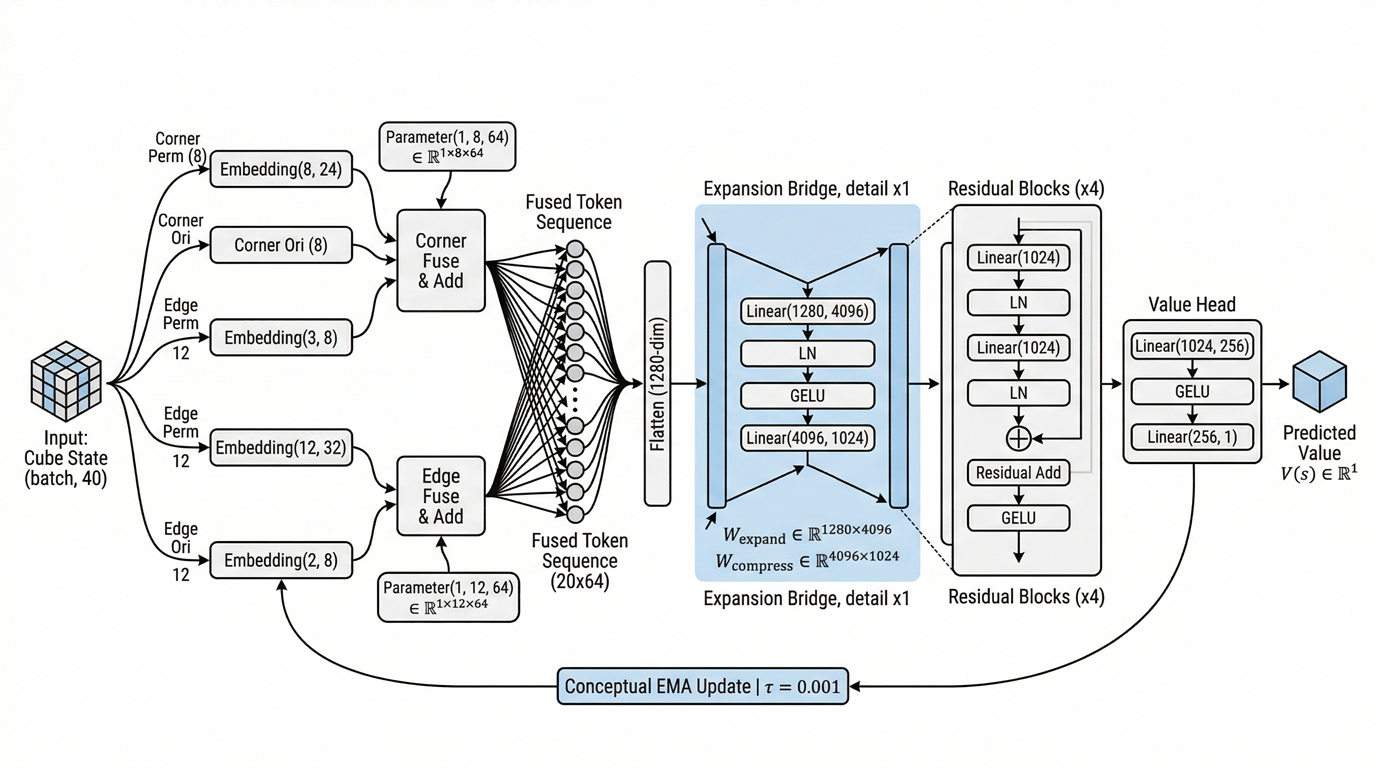
Dense Piece-Embedding: Treating categorical piece IDs (0~11) as raw integers causes the network to misinterpret them as physical magnitudes. By translating the 40 piece properties (Permutations/Orientations) into 64-dim dense vectors, we eliminated the sparsity of One-Hot encoding and directly injected the cube's mathematical topology into the network.
4096-dim Expansion Bridge: To digest the state space that explodes to 3 million combinations at Level 6, the 1280-dim fused tokens are brutally expanded into a 4096-dim bottleneck. This serves as a massive memory canvas, giving the model the sheer capacity required to map the exponential branches.
Search Engine
A pure greedy search is notoriously brittle, possessing zero tolerance for even the slightest evaluation errors. While our ValueResMLP serves as an exceptional heuristic compass, its true potential can only be unlocked and proven by a robust, heavily optimized search architecture.
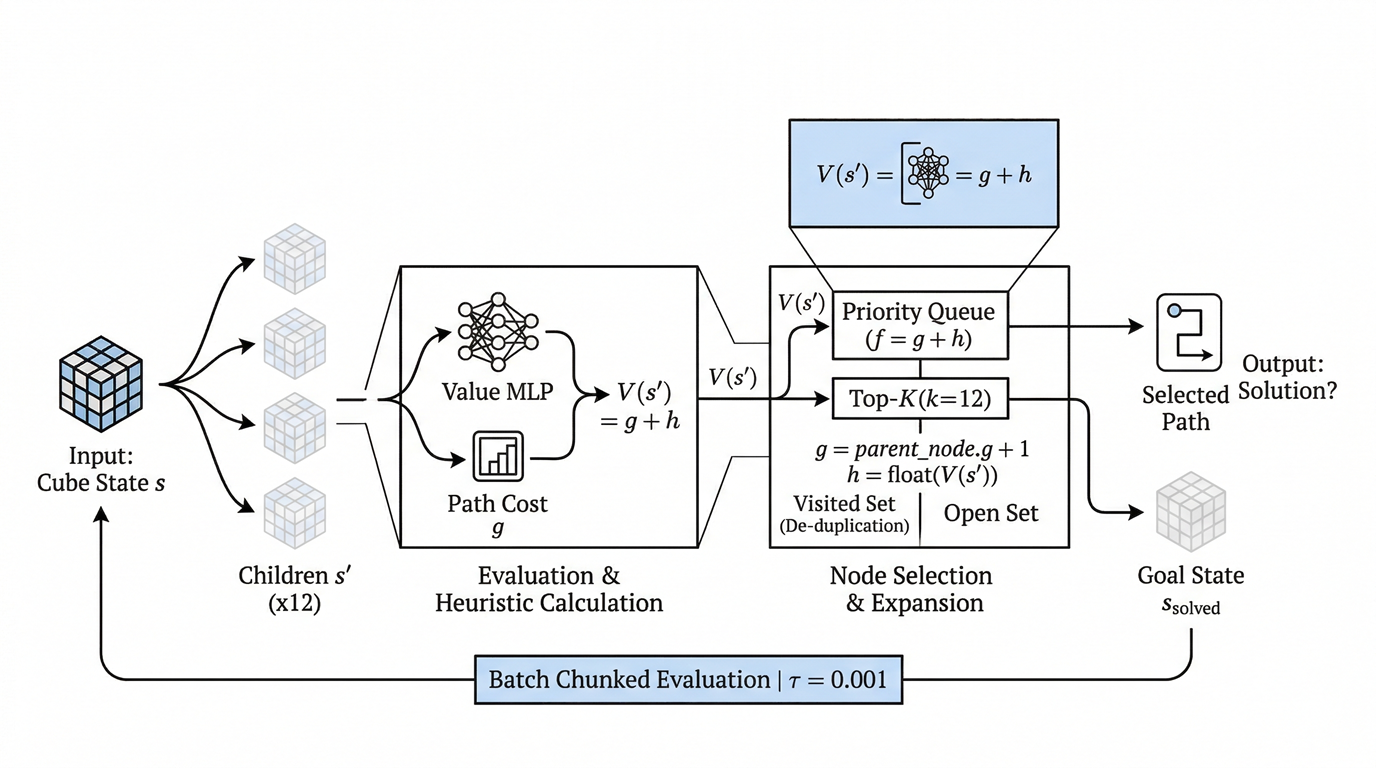
Weighted A* Search: Weighted A* Search to prevent the agent from getting trapped in shallow local minima, we upgraded the standard search to a Weighted A* algorithm. Instead of balancing the accumulated path cost () and the estimated heuristic () equally, we force the engine to aggressively trust the neural network's intuition. By applying a weight multiplier (), the search heavily prioritizes the model's predictive power, drastically accelerating the descent toward the solved state.
Conclusion
CubeNet M3 proves that even the most exceptional neural architectures will fail if the training data contains mathematical contradictions. By embracing the pure reinforcement learning philosophy of DeepCubeA and backing it with a highly specialized Piece-Embedding engine, M3 successfully shattered the previous version's plateau. The model is no longer just memorizing scrambles; it is finally understanding the mathematics of the cube.